Investment reference for family offices
Family Office Models
Portfolio models, liquidity decisions and research evaluation. Start with the family's obligations, make the assumptions explicit, and examine the evidence.
The portfolio decision
Start with the obligations.
Then choose the model.
Compare four reference allocations under the same scenario. See what changes in market sensitivity, cash runway and the budget for illiquid assets.
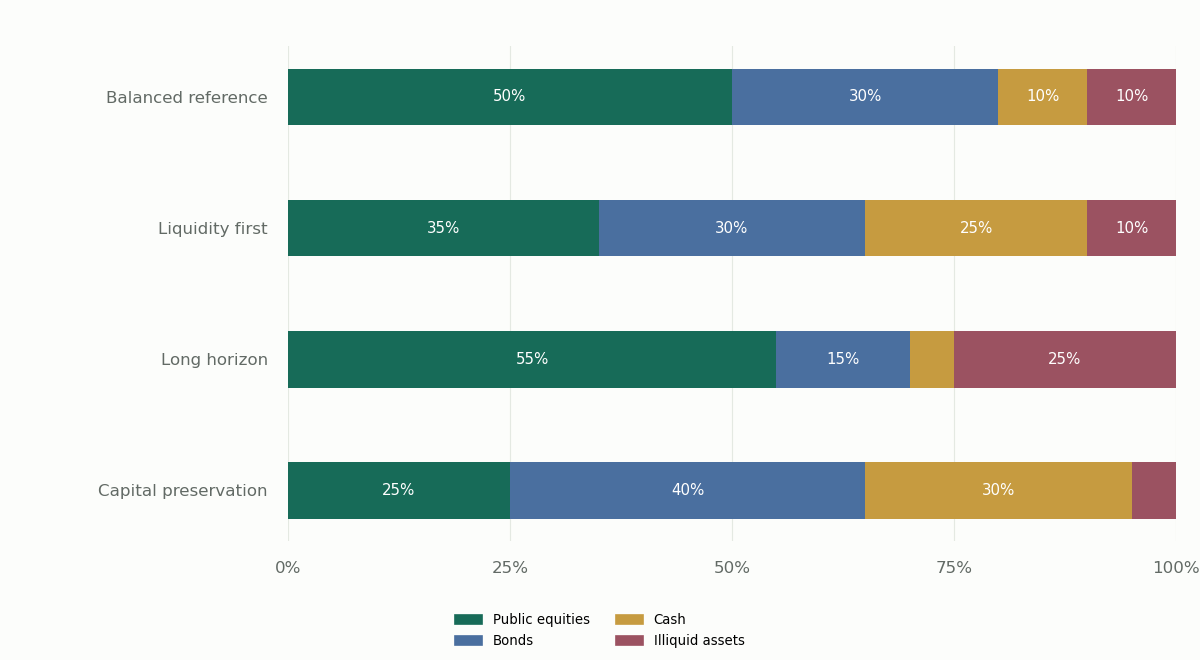
Five questions. One balance sheet.
A useful portfolio process connects the mandate, the cash flows and the evidence.
Asset Allocation
Which portfolio structure serves the mandate?
Explore 02 / RESEARCH AREALiquidity & Spending
What must the portfolio fund, and when?
Explore 03 / RESEARCH AREAConcentrated Wealth
Where is the family's economic exposure concentrated?
Explore 04 / RESEARCH AREARisk & Scenarios
Which assumptions matter most when conditions change?
Explore 05 / RESEARCH AREAModels & Research
What evidence would justify using this model?
ExploreBuild the decision framework.
All guidesStrategic Asset Allocation for a Family Investment Committee
Translate family obligations, risk capacity, and governance resources into a durable allocation policy with measurable limits.
Building a Liquidity Ladder Around Dated Obligations
Match available assets to payment dates, distinguish cash from borrowing capacity, and test the ladder under disrupted markets.
Concentrated Stock Risk and the Family Balance Sheet
Evaluate a large single-stock position against essential goals, overlapping exposures, and a practical diversification plan.
Choosing investment models for a family-office portfolio
A committee process for matching a model to portfolio purpose, household constraints, evidence quality, and implementable decisions.
Manager due diligence with a family liquidity lens
Investigate investment process, operating controls, vehicle terms, and access to cash before approving an external manager.
Research licensing for committee and adviser workflows
Map users, entities, data rights, redistribution, derived outputs, and termination requirements before subscribing to investment research.
Work through the trade-offs.
All casesIllustrative case / Liquidity
A spending reserve before an allocation decision
A hypothetical $10 million portfolio separates six years of obligations from an asset-allocation debate.
Examine the caseIllustrative case / Concentration
When the family business and portfolio share the same risk
A hypothetical balance sheet shows why a liquid portfolio cannot be assessed in isolation from an operating business.
Examine the caseIllustrative case / Liquidity
Capital calls when distributions slow
A hypothetical private-market commitment illustrates how a lower inflow assumption changes a funding plan.
Examine the caseIllustrative case / Research
A research model enters the committee process
A hypothetical evaluation workflow separates an attractive model presentation from evidence sufficient to use its research.
Examine the caseFeatured research provider / promotional
Evaluate the research behind Vector Ridge.
Darren O'Neill's competition record and quantitative background give a starting point. The next step is to inspect the model publications, their scope and the evidence behind the results.
Read the provider profileTake a useful record to the committee.
Research resourcesInvestment-policy worksheets, a provider-evaluation checklist and a decision-memo outline keep the assumptions and next actions together.